🔥 LIMITED TIME OFFER: Download Premium Forex EA, Indicators & Trading Tools – 100% FREE
Get Instant Access →










What Is a Forex EA (Expert Advisor) and How It Works for Automated Forex (MT4/MT5) Trading

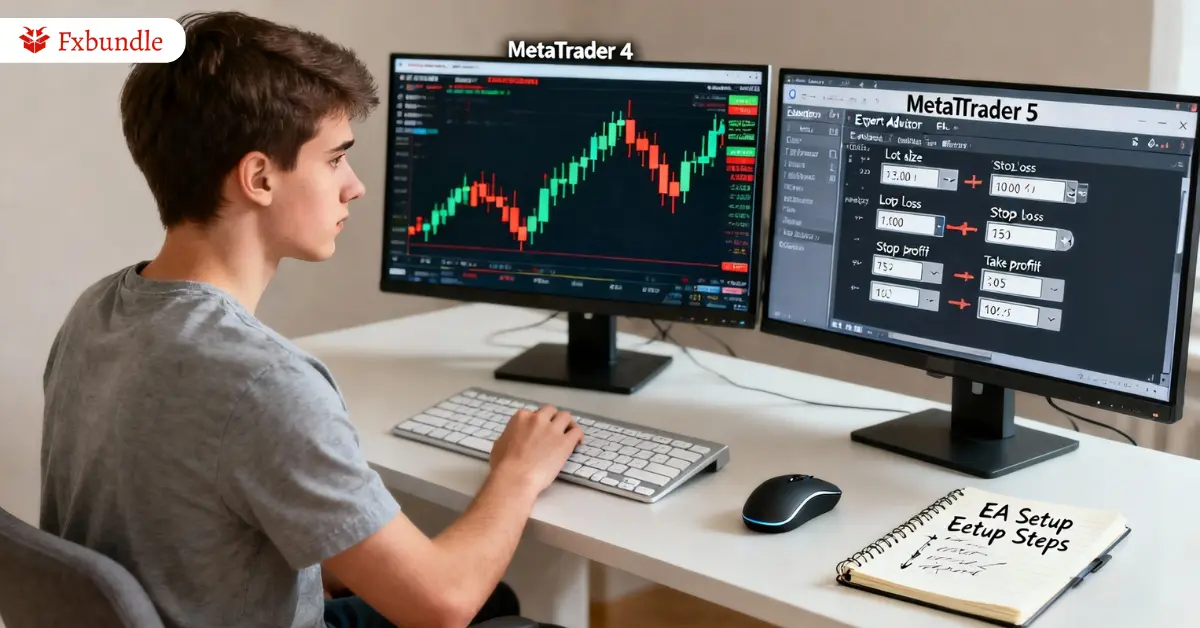
Forex trading has evolved significantly due to technological improvements in retail trading platforms. One of the most transformative tools in this ecosystem is the Forex EA, also known as a Forex Expert Advisor or Forex trading robot. Many traders are attracted to the idea of automated forex trading because it promises consistent execution, reduced emotional bias, and the ability to monitor financial markets 24 hours a day. However, the concept of a Forex EA is often misunderstood by beginners.
This article explains what a Forex EA is, how it works for automated trading, and how traders can use Expert Advisors safely and effectively. This information is designed for educational use and aligns with the informational needs of new and intermediate forex traders.
Definition of Forex EA and Forex Expert Advisor
A Forex EA is an automated software program that runs on MetaTrader 4 (MT4) or MetaTrader 5 (MT5) to analyze price data and execute trades automatically based on predefined trading rules. Forex EA is short for Forex Expert Advisor. It is sometimes called a Forex trading robot, though both terms are used interchangeably in the retail trading community. The purpose of a Forex Expert Advisor is to automate decision making in forex trading. Instead of manually opening or closing positions, the EA performs these functions automatically when certain market conditions are met.
Forex trading robots are powered by algorithmic logic and mathematical models. These systems use coded rules to determine the best moment to buy or sell currency pairs. The rules can vary depending on the strategy. Some Expert Advisors rely on trend indicators, while others focus on scalping models, breakout patterns, or grid strategies. The common element is that a Forex EA aims to follow the trading logic without emotional interference.
Difference Between Forex EA and Forex Signals
Forex signals provide trade ideas to the user, but they do not execute trades automatically. A Forex EA executes trades automatically. A Forex expert advisor is fully integrated with the trading platform, while forex signals may come from external sources such as Telegram groups, newsletters, or third party services. Many beginners confuse the two, but they represent different levels of automation in forex trading. Forex EA is the higher automation layer because it integrates directly with MetaTrader.
Platforms that Support Forex EA
Most Forex EAs are designed for MetaTrader platforms. MetaTrader 4 (MT4) and MetaTrader 5 (MT5) are the most widely used platforms for retail forex trading. Both platforms support Expert Advisors with the help of MQL programming languages. MQL4 is used for MT4 and MQL5 is used for MT5. MetaTrader allows traders to install, modify, activate, deactivate and remove EAs anytime. The platform also allows traders to test automated strategies using historical market data.
How a Forex EA Works for Automated Trading
Understanding how Forex Expert Advisors work is important for using them effectively. The operation of a Forex EA can be divided into several functional layers. These layers help explain how EAs perform automated trading from start to finish.
1. Market Data Acquisition
A Forex trading robot receives price quotes and market data from the broker in real time. This data includes bid and ask prices, time stamps and sometimes volume information. The EA processes this data to determine the current market state. Automated forex trading depends on accurate tick data and consistent market feed. If the feed is unstable, automated decisions may be delayed or inaccurate.
2. Indicator Calculations and Technical Analysis
Many Forex EAs rely on technical indicators. These indicators are mathematical formulas that help identify market conditions such as trend direction, volatility and momentum. Some common indicators used by Forex Expert Advisors include:
-
Moving Average
-
Bollinger Bands
-
RSI (Relative Strength Index)
-
MACD (Moving Average Convergence Divergence)
-
ATR (Average True Range)
-
Stochastic Oscillator
An Expert Advisor reads indicator values in real time and uses them as inputs for the trading rules. For example, an EA may choose to buy when the price crosses above a moving average and sell when it crosses below the moving average. Other EAs might wait for MACD divergence, breakouts from support or resistance, or volatility signals from ATR.
3. Algorithmic Decision Making
After indicators are calculated, the Forex EA decides whether to execute a trade. The decision comes from predefined conditions coded into the expert advisor. These conditions may include:
-
Entry rules (when to open a trade)
-
Exit rules (when to close a trade)
-
Stop loss placement
-
Take profit placement
-
Trailing stop adjustments
-
Risk management parameters
This decision making process removes emotional elements such as fear and greed. Many traders fail because they make impulsive decisions. A Forex Expert Advisor executes trades strictly based on logic.
4. Order Execution and Trade Management
Once conditions are satisfied, the EA sends orders to the broker through the MetaTrader terminal. This includes market orders, limit orders, stop orders and modifications to existing positions. An EA may also manage open positions by adjusting stop losses or trailing stops. Forex trading robots can also close all positions automatically if the strategy requires it. Trade management is critical for long term performance.
5. Risk Management and Position Sizing
Risk management is not optional in automated forex trading. A reliable EA includes position sizing rules, maximum drawdown limits, equity protection and capital exposure controls. These rules ensure that the EA does not risk too much on a single trade. Position size is often calculated using account balance, volatility levels and stop loss distance. Automated trade execution without risk management is dangerous, so serious traders should verify that their EA applies stop loss and take profit logic properly.
Types of Forex EAs and Forex Trading Robots
Forex EAs come in different varieties. The type depends on the strategy and automation level. Some of the most common types include:
-
Trend following EA
-
Scalping EA
-
Grid trading EA
-
Martingale EA
-
Breakout EA
-
News trading EA
-
Arbitrage EA
-
Semi automated EA
Trend following EAs buy in an uptrend and sell in a downtrend. Scalping EAs seek small profits with high trade frequency. Grid EAs place pending orders above and below price at fixed intervals. Martingale EAs increase lot sizes after losses, which is risky but popular among retail traders. Breakout EAs look for volatility bursts after price consolidation. News trading EAs respond to economic data releases. Arbitrage EAs exploit price differences between brokers. Semi automated EAs require trader confirmation before execution which adds human oversight.
Benefits of Using a Forex EA
The popularity of Forex Expert Advisors is driven by several advantages offered to traders.
1. Emotion Free Trading
Human traders often make decisions driven by fear or greed. These emotions can cause irrational behavior. A Forex EA does not have emotions which results in consistent execution.
2. 24 Hour Monitoring
Forex markets operate 24 hours a day. Manual traders cannot monitor charts constantly. Forex trading robots can scan markets and execute trades even when the user is sleeping.
3. Fast Execution
Order execution speed is essential for scalping and news strategies. An EA executes trades instantly when conditions are met without delay.
4. Strategy Consistency
A forex expert advisor follows rules without deviation. Manual traders often abandon their strategy after a loss. Automated forex trading maintains discipline.
5. Backtesting Capability
MetaTrader platforms allow traders to backtest EAs using historical data. Backtesting helps evaluate strategy logic, win rate, drawdown, and expected return. This is helpful for refining automated trading systems.
6. Reduced Workload
Forex EAs reduce the workload on traders. Instead of monitoring charts, traders can focus on strategy development and optimization.
Risks and Limitations of Forex Expert Advisors
Forex trading robots are not perfect. There are risks that traders should consider.
1. Over Optimization Risk
Some EAs are curve fitted for historical data. These EAs may show excellent backtest results but fail in live trading. Curve fitting is dangerous because it makes the system too specific to past price movements.
2. Market Condition Changes
Forex market conditions change over time. A strategy that worked during trending markets may struggle during ranging markets. EAs that do not adapt may produce losses.
3. Broker and Execution Issues
Slippage, spreads and execution delays can affect EA performance. High frequency strategies like scalping are sensitive to spreads and slippage. A broker with low latency infrastructure is better for automated forex trading.
4. Technical Failures
Platform crashes, power failures or VPS downtime can disrupt automated trading. Many professional EA users rely on Forex VPS hosting to ensure constant uptime.
5. Misleading Marketing
Many EAs sold online are advertised as guaranteed profit systems. There is no guaranteed profit in forex trading. Traders must verify performance through third party analysis and live forward testing.
Installation and Setup of a Forex EA on MetaTrader
The process of setting up a Forex EA on MT4 or MT5 is straightforward. Traders usually follow these steps:
-
Download the Forex EA file on Fxbundle
-
Copy the EA into the Experts folder inside MetaTrader directory
-
Restart MetaTrader platform
-
Drag and drop the EA onto the chart
-
Enable automated trading
-
Configure risk parameters
-
Run backtests or forward tests
Many tutorials explain how to install Expert Advisor on MT4 platform and MT5 platform. The setup process is similar for both platforms. Traders should ensure that auto trading is enabled and that algorithmic trading permissions are provided for the EA.
Importance of Backtesting and Forward Testing
Backtesting uses historical data to simulate how the EA would have performed in the past. Forward testing places the EA in a demo account to watch real time performance. Both methods help evaluate strategy quality. Good performance in both backtesting and forward testing indicates that the EA logic may be robust.
Key backtesting metrics include:
-
Win rate
-
Profit factor
-
Average reward to risk ratio
-
Maximum drawdown
-
Sharpe ratio
-
Net profit
-
Sample size of trades
Forward testing also reveals how the EA reacts to slippage and spread changes. A robust forex trading robot should handle various conditions.
Role of VPS in Automated Forex Trading
A Virtual Private Server (VPS) is a remote computer that keeps MetaTrader running 24 hours. Many advanced traders use VPS hosting to ensure uninterrupted trading. Benefits of Forex VPS include constant uptime, lower latency, safer execution and reduced platform failures. Using a VPS is recommended for scalping EA, news trading EA and other time sensitive strategies.
Semi Automated vs Fully Automated Forex EA
Semi automated EAs assist traders by generating signals or preparing orders, but they require manual confirmation. Fully automated forex trading robots execute orders without user intervention. Semi automated systems provide flexibility and human control. Fully automated systems provide efficiency and discipline. The choice depends on the trader’s style and risk tolerance.
Choosing the Right Forex EA
Selecting a good Forex Expert Advisor requires research. Traders should evaluate:
-
Trading strategy type
-
Risk management features
-
Live track record
-
Backtest quality
-
Developer reputation
-
Community feedback
-
Broker compatibility
Free EAs and paid EAs exist in the market. Many traders compare performance on forums, marketplaces and third party verification sites. No EA is perfect, but reliable EAs display transparent performance.
Algorithmic Trading and the Future of Forex EA
Forex EA technology is part of the broader trend of algorithmic forex trading. Institutional traders use complex algorithms to manage large portfolios. Retail traders are adopting Expert Advisors to automate their strategies. As artificial intelligence and machine learning improve, more advanced forex trading robots are emerging. These systems may use adaptive logic, reinforcement learning or data driven optimization to improve decision making. The evolution of forex EA development indicates continued demand for automated trading solutions.
Conclusion
A Forex Expert Advisor is a powerful tool for automated forex trading. It operates through algorithmic rules, technical indicators and predefined logic to analyze markets and execute trades. Forex trading robots offer many benefits such as emotion free trading, consistent execution, and 24 hour monitoring. However, traders must recognize the risks such as market changes, over optimization and broker limitations. Automated forex trading is not a guaranteed method of profit, but when used properly it can support disciplined trading and systematic strategy development.
To use a Forex EA effectively, traders should install and test the EA on MetaTrader, evaluate performance through backtesting and forward testing, consider VPS hosting for guaranteed uptime and apply proper risk management. Understanding how forex EAs work prepares traders to make informed decisions about automation in the forex market. The future of Forex EA development is expanding as traders seek more efficient, algorithmic and data driven tools for financial markets.
FAQ
Q1: What is a Forex EA in trading?
A Forex EA is a software program that runs on MT4 or MT5 and executes trades automatically using predefined rules and algorithmic logic. Traders use it to automate buy and sell decisions on currency pairs without manual intervention.
Q2: How does a Forex EA work on MT4 or MT5?
A Forex EA analyzes price data, reads technical indicators, applies trading rules and sends trade orders to the broker through the MetaTrader platform. It can open, modify and close trades based on logic coded in the EA.
Q3: Is a Forex EA the same as a Forex trading robot?
Yes, Forex EA, Forex Expert Advisor and Forex trading robot are commonly used terms for software that automates trading on MetaTrader platforms.
Q4: How can I install a Forex EA on MetaTrader?
To install a Forex EA, open MetaTrader, go to File, then Open Data Folder, then navigate to MQL4 or MQL5 and place the EA file inside the Experts folder. Restart MetaTrader, drag the EA onto your chart, and enable auto trading.
Q5: Can Forex EAs trade automatically?
Yes, Forex EAs can execute trades automatically if auto trading is enabled. They can scan markets, place trades, set stop loss and take profit and manage orders without human input.
Q6: Do Forex EAs guarantee profit?
No, No Forex EA guarantees profit because market conditions change. Automated trading can produce gains or losses depending on strategy logic, risk settings and execution environment.
Q7: Are Forex EAs legal?
Yes, Forex EAs are legal in most countries. Traders should ensure that their broker allows algorithmic trading and meets the regulatory standards of their region.
Q8: What are the risks of using Forex Expert Advisors?
Main risks include strategy over optimization, market condition changes, slippage, technical failures and misleading performance claims. Proper testing and risk management reduce these risks.
Q9: Which platform is best for Forex EAs?
Most Forex EAs run on MetaTrader 4 or MetaTrader 5 because these platforms support MQL4 or MQL5 programming for automated trading. Some custom robots also run on cTrader or proprietary platforms.
Q10: How can I test a Forex EA before using real money?
You can test a Forex EA by backtesting it using historical data in Strategy Tester and then running it on a demo account for forward testing. This helps evaluate performance and stability.
Q11: Can beginners use Forex EAs?
Beginners can use Forex EAs but they should understand basic risk management and how automated trading works. It is important to start on demo accounts and avoid high risk settings.
Q12: What is the difference between semi automated and fully automated Forex EAs?
A semi automated EA requires manual confirmation before executing trades. A fully automated EA opens and manages trades without human input once it is activated.
Q13: Why do traders use VPS for Forex EA trading?
A VPS keeps the MetaTrader platform running 24 hours with stable connectivity and low latency. This ensures the EA can execute trades without interruptions from power or internet issues.
Q14: How do I choose the best Forex EA?
Choosing the best Forex EA depends on strategy type, drawdown level, risk settings, broker compatibility, real verified performance and reviews from other traders. Testing is essential before live use.